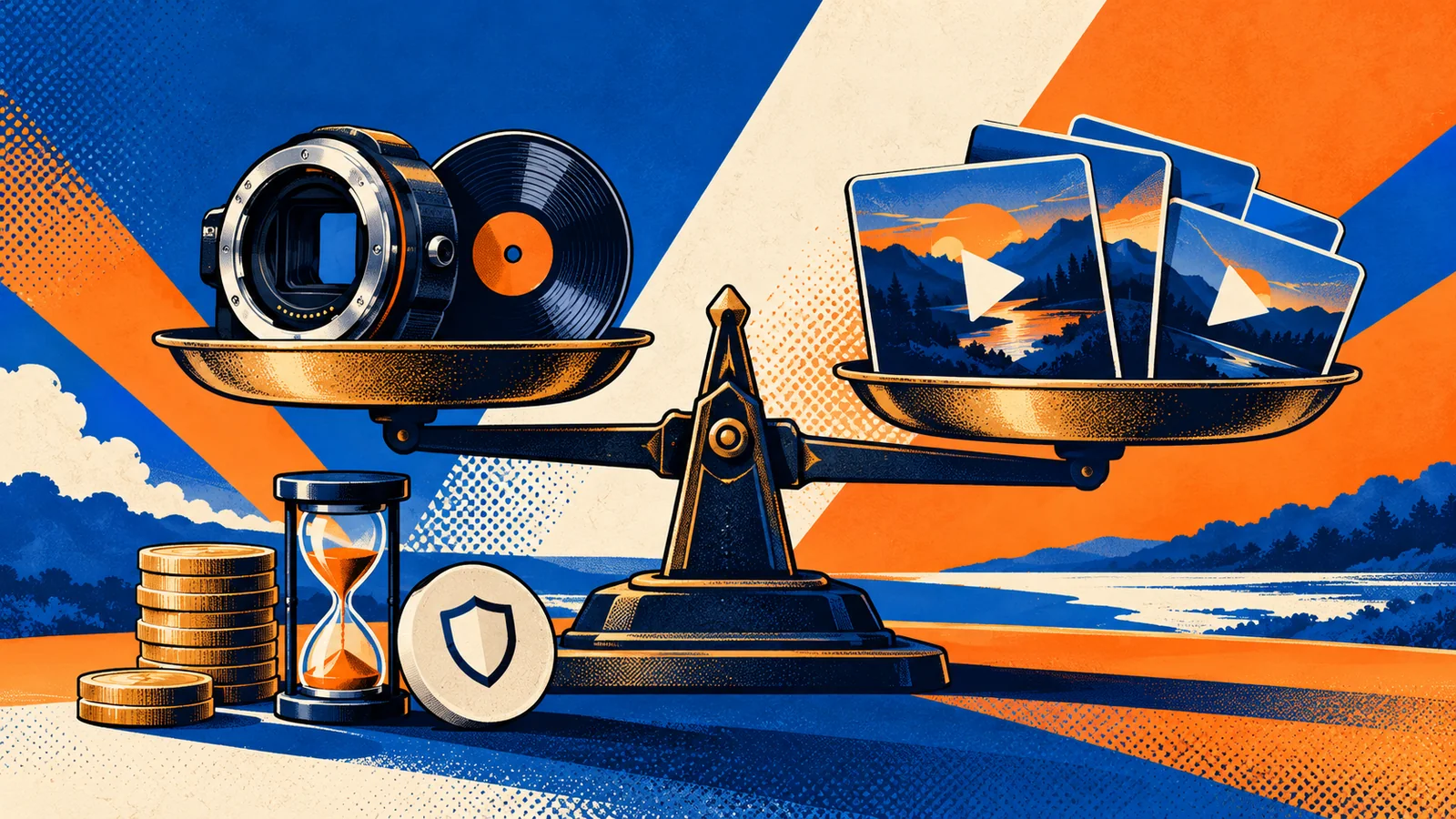
“Free music” describes a price, not a permission. A track can cost nothing to download and still be unsuitable for a client film, paid ad, podcast, livestream, or cross-platform release. Conversely, a work may be usable without a fee because it is public domain, while the particular recording you found remains protected. The useful comparison is therefore not “which library has the most tracks?” It is “which permission can I prove for this exact use, and what happens if the project changes?”
This guide compares six routes: YouTube’s Audio Library, public-domain material, Creative Commons licenses, platform libraries, free tiers of commercial services, and direct permission. Treat the labels as starting points. Before publishing, write down destination, commercial context, territory, term, edits, attribution, and ownership. Those fields turn a vague search into a rights brief.
Begin with the use, not the source
Answer these questions before auditioning music:
- Is the release organic, monetized, sponsored, client-owned, or a paid advertisement?
- Where will it appear: one platform, a website, broadcast, internal channels, or several territories?
- Is the permission perpetual, or does it end with a plan, campaign, or account?
- Will you trim, loop, pitch, remix, add lyrics, make a stem, or use the track in a template?
- Must the audience receive attribution, and can you keep it visible in every placement?
- Who needs the permission: you, an agency, a client, or a brand running the ad?
- What is your response if a platform produces a claim?
The seventh question matters because a Content ID claim is a platform event, not a simple verdict on your license. YouTube explains that Content ID may block, monetize, or track a match, sometimes differently by geography. Keep evidence rather than promising a source is “claim-proof.”
Six source types, six different tradeoffs
1. YouTube Audio Library
The Audio Library is the clearest first stop when the final destination is YouTube. Its official help page identifies music and sound effects available through the library and provides an attribution filter. Some tracks require credit; others are marked as not requiring attribution. Copy the exact title, artist, license information, and required credit into the project record at the time of download.
That convenience is not a universal commercial license. Read the current track information and platform terms. A track found in YouTube should not automatically be treated as cleared for a client television spot, paid placement elsewhere, podcast, or website. If the edit will travel, ask whether permission follows the file or only covers the stated platform context. When unclear, select written permission that covers every destination.
The practical tradeoff is traceability versus portability. Preserve the track identifier, download date, terms, and version used; do not rely on a later search result to reconstruct a download.
2. Public-domain music
Public domain means a particular work is no longer protected by copyright, or was never protected in the relevant jurisdiction. It does not mean “old-sounding” or “available on a free website.” The U.S. Copyright Office explains that a musical composition and a sound recording are separate works. A centuries-old composition may be public domain while a modern recording remains protected.
Term also varies by country and by publication history. The U.S. Copyright Office describes duration as dependent on factors including creation, publication, and authorship. Therefore, a public-domain conclusion made for a U.S. release may not answer the question for a worldwide campaign. Keep the reasoning: work title, composer, edition, recording performer, source archive, jurisdiction, and the date you checked the status.
Public domain is attractive for long-lived projects because there is no licensor to renew with. The tradeoff is verification and recording choice. Use a recording that is itself cleared, commission your own performance, or obtain permission for the recording. Do not download an attractive modern performance and label it public domain merely because the underlying melody is old.
3. Creative Commons
Creative Commons is a family of licenses, not a synonym for unrestricted. The official license guide says all six main licenses require attribution, while their other conditions differ. CC BY permits commercial reuse and adaptation with credit. CC BY-SA permits adaptation but requires the adapted work to carry the same licensing terms. CC BY-ND allows commercial reuse only if the work is not shared in adapted form. Licenses containing NC are noncommercial; NC is a poor fit for paid ads, sponsored content, client work, or a monetized channel unless the licensor confirms that the planned use is noncommercial.
“Adaptation” needs a production answer. Trimming for duration, looping, mixing under speech, changing pitch, or combining a track with original material may be treated differently under a license or local law. If ND applies, ask before editing rather than assuming that a synchronized edit is merely a technical change. With SA, check whether the final audiovisual work or the music component triggers the required licensing treatment; if that question affects a commercial release, get specialist advice.
Attribution should travel with the export: creator, title, source URL, license name and version, and a license link where practical. Keep the original page or a dated record because it can change. Verify uploader authority; CC licensing does not automatically clear trademarks, privacy, publicity, samples, or other third-party material.
4. Platform libraries
An in-app “music” button is a platform library, even when the platform does not call it a license marketplace. Its permission may depend on account type, region, content format, or whether the post is personal, commercial, or an advertisement. A sound available for an ordinary post may be unavailable to a business account or unusable when the video is downloaded and delivered to a client.
The library’s strength is workflow fit: the platform can attach the sound and apply its own rules during publishing. Its weakness is portability. Cross-posting, embedding, boosting, whitelisting, or retaining the master after an account closes can change the use. Before approving a campaign, confirm the platform’s current terms for the exact account and destination. Save the sound name, creator, in-app screen or terms, account context, and date. If the platform later removes the sound, you need a replacement plan rather than a claim that the old selection was universally cleared.
5. Free tiers and “free” commercial libraries
A free tier is usually a limited subscription offer, not a public-domain dedication. The restriction may concern downloads, catalog access, attribution, monetization, client work, paid advertising, territory, or the number of projects. “Royalty-free” also does not mean “copyright-free”: it normally describes how royalties are handled under a license.
Read the operative license, not only the pricing page. Record whether a download made during the free period remains cleared after cancellation, whether published projects are grandfathered, and whether new campaigns need an active plan. Check if the permission covers a client’s account, paid media, templates, podcasts, and re-edits. Save the invoice or free-plan confirmation, track ID, license text, and relevant terms version.
The tradeoff is convenience against dependency. A library may be efficient for a repeatable workflow, but cancellation, account loss, catalog changes, or a plan boundary can create an exit task. Do not put a track into a reusable template until you know whether every future user inherits the permission.
6. Direct permission
Direct permission is often the most flexible route when a client needs broad, durable use. Ask the actual rights holders for written permission that names the composition and the specific recording. The Copyright Office’s musician guidance is a useful reminder that those are separate rights and may be owned by different people.
The permission should state media, territory, term, paid promotion, client and agency rights, edits, sublicensing, exclusivity, attribution, claims handling, and whether the fee is zero. Identify the signer and their authority. A friendly message saying “sure, use it” may not answer whether a label, co-writer, publisher, or performer also must consent.
The tradeoff is administrative work. Direct permission solves ambiguity only if authority and scope are documented. Keep the signed message, attachments, rightsholder names, and final asset identifier with the project.
Use a comparison record
| Source | Best evidence | Typical boundary | Exit question |
|---|---|---|---|
| YouTube Audio Library | Track page, attribution status, download record | YouTube context may not equal cross-platform clearance | Can the client reuse the file elsewhere? |
| Public domain | Status research plus cleared recording | Composition and recording can have different terms | Does the conclusion hold in every territory? |
| Creative Commons | Exact license deed and attribution record | NC, ND, SA, and third-party rights | Can the edit and commercial use fit the license? |
| Platform library | Account-specific terms and in-app record | Account, region, ad, and export restrictions | What happens if the sound disappears? |
| Free tier | Plan terms and download/license receipt | Active plan, catalog, client, or campaign limits | What survives cancellation? |
| Direct permission | Written authorization from all relevant owners | Scope or authority may be incomplete | Is renewal or a new use required? |
This table is a decision aid, not a guarantee. A missing field is a stop signal. “No attribution required” does not answer territory, ads, or recording ownership; “public domain” does not answer which file you downloaded.
Build an evidence chain and a claim response
For every chosen track, keep a small ledger: title, artist, composition and recording identifiers, source URL, license or permission, attribution text, destination, territory, term, commercial status, edit notes, account or plan, download date, and reviewer. Save a PDF or screenshot of important terms where permitted, plus the exact audio file and a checksum or stable project reference.
If YouTube raises a Content ID claim, compare the claim’s claimant and asset with your ledger. A valid license may be a reason to dispute, but YouTube says it cannot decide whether your dispute is legally correct. Use the platform’s process, attach the relevant proof, and pause paid distribution if the claim affects delivery. Do not dispute merely because a track was labeled free.
Cancellation and exit gate
Before canceling an account or changing platforms, list every published and scheduled use. Confirm which licenses continue, download permitted replacement files, preserve attribution, and note the last date for new use. If a platform library no longer supplies a sound, replace or mute it in masters where the permission does not continue. Keep the old evidence with the archived project; do not rewrite history by deleting the record.
Publish only when the intended use, exact file, rights chain, attribution, destination, territory, term, and claim plan are all recorded. If any one is unknown, choose a narrower use, obtain permission, substitute the music, or ask qualified counsel. Free is a budget description. A publishable track is one whose permission survives scrutiny and whose future exit is understandable.
Sources and scope
- YouTube Help — Use music and sound effects from the Audio Library — official platform documentation for library access and attribution filtering; accessed 2026-09-15.
- YouTube Help — How Content ID works — official explanation of matching, geography-specific policies, and possible claim outcomes; accessed 2026-09-15.
- Creative Commons — Creative Commons Licenses — official license-condition summaries; accessed 2026-09-15.
- Creative Commons — License Your Work — official guidance on making license and attribution information clear; accessed 2026-09-15.
- U.S. Copyright Office — What Musicians Should Know about Copyright — official distinction between musical works and sound recordings; accessed 2026-09-15.
- U.S. Copyright Office — How Long Does Copyright Protection Last? — official duration factors; accessed 2026-09-15.
- U.S. Copyright Office — Musical Compositions and Sound Recordings — official registration guidance identifying separate works; accessed 2026-09-15.
This article is educational editorial guidance, not legal advice. Copyright, contract, privacy, publicity, and platform rules can differ by jurisdiction and change over time; obtain qualified advice for a high-value campaign or disputed claim. The comparison and workflow are Angry Media editorial synthesis of the cited primary sources. No performance, claim-free, or universal cross-platform guarantee is made.