Compare creator music libraries by running the same real briefs through each service and documenting what can actually be licensed. Catalog size, famous-client logos and a low introductory price do not tell you whether a library fits your sound, clients, platforms or evidence workflow.
The output of this guide is a dated comparison packet: one use profile, three blind briefs, a rights matrix, a cost model and a sample license archive. It deliberately avoids a universal winner.
Freeze one use profile
Write the work you expect during the next review period:
- creator, company or agency that will be the licensee;
- team members and freelancers who need access;
- number and type of projects;
- creator-owned, client-owned and shared publication accounts;
- organic, monetized, sponsored and paid-ad uses;
- platforms, websites, events, broadcast or physical locations;
- territories and campaign duration;
- master edits, cutdowns, translations and later revisions;
- delivery of finished video, project files or isolated audio;
- expected publication and archive life.
Every library must be compared against the same profile. A cheap plan that excludes client advertising is not a cheaper version of a plan that includes it.
Record the date and exact terms or plan documents used. License scope and product packaging change.
Protect the two separate works
The U.S. Copyright Office explains that a musical composition and a particular sound recording are separate works. A library may be authorised to license the permissions your project needs, but the conclusion must come from the agreement for the exact asset—not from “royalty-free,” “copyright-safe” or another marketing label.
For every shortlisted track, capture:
- exact title, version and asset ID;
- composer and recording information shown;
- provider and named licensor;
- agreement or certificate tied to the download;
- media, platform, territory and term covered;
- attribution, cue-sheet or registration duties;
- restrictions on standalone distribution, remixing or template use.
If ownership or authority is unclear, exclude the track from the scored shortlist until resolved.
Design three blind creative briefs
Use briefs representative of your work, not search terms tailored to one catalog. For example:
- Spoken tutorial: restrained pulse, space for speech, clean ending at 35 seconds.
- Product demonstration: clear build, two edit points, energetic but not aggressive, 20- and 10-second versions.
- Reflective story: warm, non-sentimental texture, no distracting lead melody, 60-second arc.
Define functional requirements before opening any service: duration, energy curve, vocal density, instrumentation to avoid, edit points, stems and destination use.
Hide provider names while the editor or stakeholder reviews downloaded previews when practical. This reduces the influence of brand familiarity and interface polish on the creative decision.
Score usable fit, not catalog volume
For each brief, stop after a fixed search window and record:
| Measure | Library A | Library B | Library C |
|---|---|---|---|
| Minutes to first credible candidate | [input] | [input] | [input] |
| Credible candidates found | [input] | [input] | [input] |
| Candidates that pass rights screen | [input] | [input] | [input] |
| Useful alternate versions or stems | [input] | [input] | [input] |
| Shortlist approved blind | [input] | [input] | [input] |
| Evidence package complete | [yes/no] | [yes/no] | [yes/no] |
A million-track claim is irrelevant if none of the tested results survives the brief and rights screen. Conversely, one suitable track does not prove the library will support recurring work. Repeat across distinct briefs.
Do not score “music quality” as a single number. Note arrangement fit, recording quality, editability, distinctiveness and suitability under dialogue separately.
Test search as a production tool
Run the same natural-language concepts and functional filters. Observe:
- whether filters describe musical function or only broad mood;
- whether excluded vocals, instruments or tempos stay excluded;
- whether similar-track results preserve the useful characteristics;
- whether version, stem and duration relationships remain clear;
- whether saved lists can be shared with collaborators;
- whether asset identity survives download and handoff.
Search speed matters because it is recurring labour. Time from brief to rights-cleared shortlist is more useful than time to the first pleasant preview.
Keep a note of failed searches. A library whose vocabulary does not match your team creates hidden browsing cost even when its catalog contains suitable music.
Build a rights matrix from operative terms
Do not accept a plan comparison page as the complete agreement. Extract answers from current terms, license summaries and the project-specific document:
| Rights question | Required answer |
|---|---|
| Legal licensee | Person, company, client or agency |
| Covered publishers | Named channels/accounts and client destinations |
| Monetization | Organic revenue and sponsored content |
| Paid media | Platforms, spend or campaign limitations |
| Versions | Cutdowns, translations, trailers and revisions |
| Territory and term | Where and for how long |
| Post-cancellation | Existing posts, unpublished work and re-uploads |
| Team use | Seats, freelancers and contractors |
| Delivery | Flattened export, project file, raw or isolated track |
| Claims | Registration and dispute process |
Quote the controlling clause or save a stable copy. “Business plan” is not an answer to any row.
YouTube’s own Audio Library illustrates why source and track details matter: its help documentation distinguishes tracks requiring attribution and directs users to the license information associated with Audio Library music. Treat every library’s asset-level conditions with the same care.
Simulate one complete project
Before a paid commitment, take a permitted preview or trial track through a mock workflow:
- search from the written brief;
- create and share a shortlist;
- verify the use profile against the license;
- download the exact version;
- edit a private test sequence;
- create the project or registration record if required;
- export a license certificate or evidence file;
- hand the package to another team member;
- retrieve it without relying on memory or browser history.
Do not publish or distribute a watermarked preview beyond trial permission. The objective is to test process, not to treat evaluation access as a production license.
Compare claim handling without promising “claim-free”
Automated recognition and licensing are different systems. A properly licensed upload can still require documentation or channel registration. Ask each provider:
- what identifiers tie the license to the track and project;
- whether channels or client accounts must be registered;
- who can submit a claim response;
- what evidence the provider supplies;
- whether support persists after cancellation;
- how the process works when a client publishes.
Test whether instructions are findable and exportable. Do not score an unverified promise that a library is “safe everywhere.” Platform rules, matching systems and provider arrangements can change.
Calculate total operating cost
Use current, dated offers and three workload cases: committed, expected and high. Include:
plan or license fees + seats + client/advertising upgrades + per-project charges + administration time + expected transition cost
Administration time includes search, rights review, project registration, evidence archiving and claim resolution. Do not invent a cash value for hypothetical claims; record actual time after use and update the model.
Model renewal and exit separately:
- What happens to published projects after cancellation?
- Can an approved project publish later?
- Can old work be re-edited or re-uploaded?
- Can certificates and invoices still be retrieved?
- How much work is required to replace saved shortlists?
An annual price is not the full switching cost, and a one-time license is not automatically unlimited.
Check team and client usability
Give the evidence packet to a collaborator who did not run the test. They should be able to answer:
- Which track version is approved?
- Where may the final video appear?
- Is paid use included?
- Who is the licensee?
- When does permission expire or require renewal?
- What must accompany a claim response?
If the answer lives only in the original researcher’s account, the workflow is fragile. Prefer a library that produces durable project evidence your actual team can operate correctly.
Accessibility and editorial fit also belong in the review. Test music under real dialogue, captions and sound effects. A track that wins in isolation may mask speech, overstate emotion or create an edit pace that harms comprehension.
Weight requirements before scoring
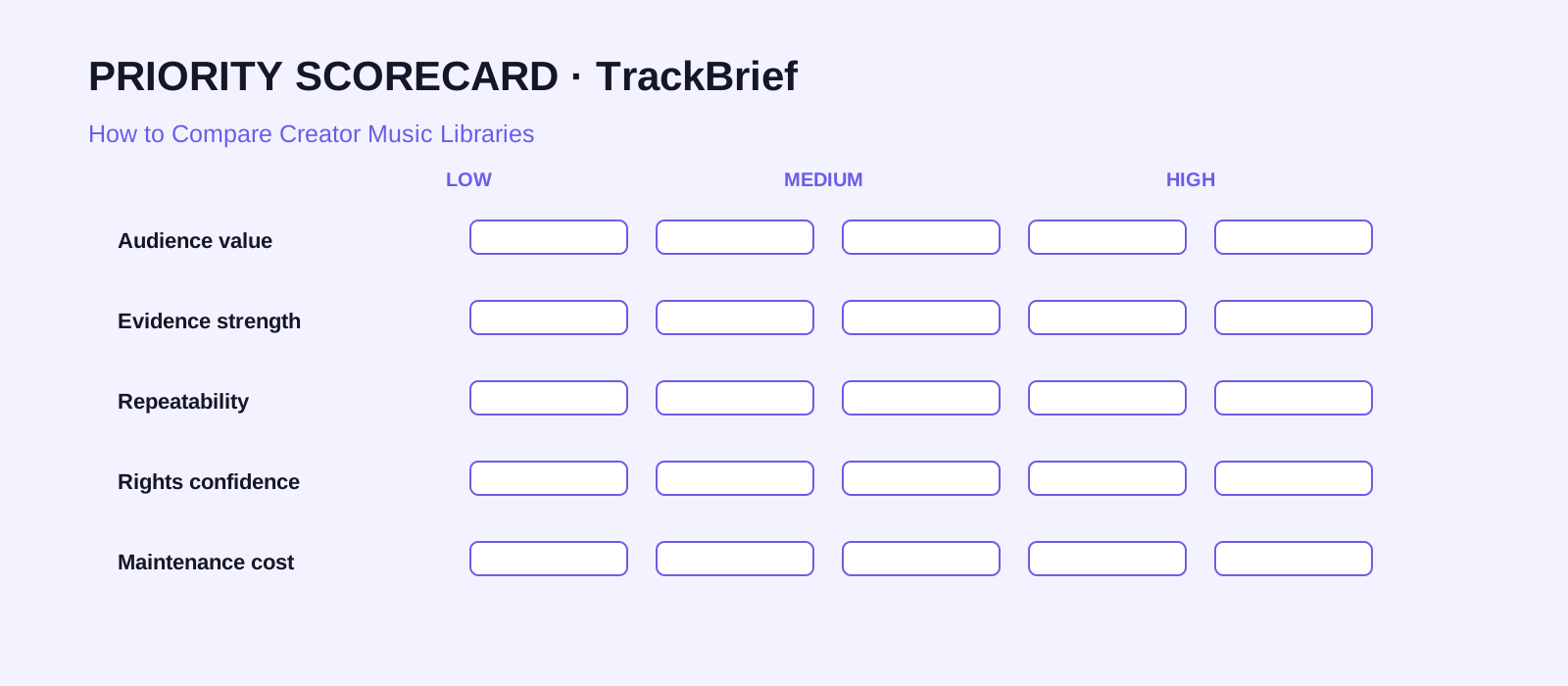
Set pass/fail requirements first. For example, client-paid media or post-cancellation coverage may be non-negotiable. A library that fails one cannot recover through a high creative score.
Then weight the remaining criteria for your work:
- creative shortlist success;
- time to rights-cleared selection;
- clarity and breadth of required permission;
- evidence durability;
- team workflow;
- cost under expected use;
- exit and renewal risk.
Keep the raw observations beside the weighted result. A score should make priorities visible, not conceal weak evidence behind a decimal.
Run a limited pilot
Choose the best passing option for a small number of ordinary projects. During the pilot, record search time, shortlist acceptance, evidence completeness, unexpected exclusions and support events. Keep music-free masters so a failed choice remains reversible.
Review before renewal or before a materially different campaign. New paid advertising, a new client workflow, broadcast use or a larger team requires a fresh rights check even if the library performed well for organic creator posts.
Release gate for the comparison
Select a library only when:
- every candidate was tested against the same written use profile;
- three representative briefs were run within equal search windows;
- creative scoring followed rather than preceded the rights screen;
- composition and recording permissions are traceable;
- paid use, clients, versions, team access and cancellation are explicit;
- a complete evidence packet can be exported and handed off;
- costs include required tiers and administration;
- non-negotiable failures cannot be averaged away;
- the pilot and review date are defined.
The best creator music library is the one that repeatedly turns your briefs into usable, licensable and provable choices. Everything else is browsing inventory.
Related resources
Sources and scope
After the neutral comparison and pilot gate, review the STIS creator music overview
- YouTube Help — Use music and sound effects from the Audio Library — official platform documentation; accessed 2026-09-14.
- U.S. Copyright Office — Musical Compositions and Sound Recordings — official authority; accessed 2026-09-14.
- Creative Commons — License considerations — official license-steward guidance; accessed 2026-09-14.
The blind-brief test, rights matrix and weighted pilot are Angry Media editorial synthesis. Library plans, catalogs, interfaces and license terms change; verify the current agreement and asset-level license for the exact use. This article is educational, not legal advice. Source review completed 2026-09-14; scheduled publication 2026-10-25.
Priority Scorecard