There is no best creator-music service in the abstract. A platform library may be efficient for one native post and unusable for a client’s paid campaign. A subscription catalogue may cover a creator’s channels but require a different plan for client work. A commissioned track may fit a brand perfectly while creating a longer rights and delivery process. Compare the permission you need, the evidence you can retrieve, and the consequences when the plan changes.
This guide compares service types and selected official service documentation by use case. It is not a ranking or a purchasing recommendation. Prices, catalogues, eligibility, claims processes, and terms change by date, account, territory, and track. The sources and service pages were checked on 2026-09-15. Read the licence attached to the specific track and plan before relying on any summary.
Start with the use case, not the catalogue size
Write a one-line brief containing the creator or client, platforms, territories, term, audience, monetisation, paid media, live use, edits, and likely future versions. Then classify the music route:
- Platform library: music made available inside a platform’s creation or business tools, often tied to that platform and account context.
- Subscription catalogue: a recurring service offering a library under plan-specific terms, usually with channel clearing, project registration, or client rules.
- One-off or direct licence: a negotiated permission for a specific track, recording, campaign, territory, term, or use.
- Commission or custom composition: new music created for the project, with ownership, revisions, performer, deliverables, and future-use terms negotiated explicitly.
These are not quality categories. They are different evidence and risk systems. A convenient library can have narrow portability; a commissioned track can have unclear ownership if the agreement is incomplete.
Use case: a personal organic post on one platform
For a creator making a personal, organic Reel, TikTok, or Short, the platform’s own library may be the fastest route. Instagram says its licensed music library is intended for personal, non-commercial use and that availability varies by account, post type, and region. Meta points creators to Sound Collection for music and sounds usable in commercial contexts such as ads.
TikTok’s Commercial Music Library is designed for business use, and TikTok’s current business guidance says commercial sounds can be used for organic or paid content when selected for the relevant region and placements. Do not assume that a personal-account sound is cleared for a client or that downloading the audio creates a cross-platform licence.
YouTube’s Audio Library and Creator Music serve YouTube workflows. YouTube’s copyright guidance recommends safe sources but warns that no route guarantees the absence of claims. For a one-platform post, keep a screenshot or export record showing the account, track, date, and permitted use. If the video may be reposted elsewhere, select a portable licence instead of treating the native library as a master source.
Use case: a recurring creator channel
A subscription catalogue can reduce repeated clearance work for a creator who publishes regularly. Epidemic Sound’s current pricing page describes coverage for platforms including YouTube, TikTok, and Instagram and distinguishes business/client work, digital ads, and commercial live streaming from ordinary creator use. Artlist describes separate Social and Pro/Business licensing models, channel clearlisting, and different client or commercial coverage.
The relevant comparison is not “which has more songs?” Ask whether the plan covers the creator’s legal entity, channels, monetisation, territories, live streams, paid promotion, and projects published after cancellation. Check whether downloaded tracks remain usable for new projects after the subscription ends, whether existing published projects remain covered, and whether a channel or video must be clearlisted to resolve platform claims.
Keep subscription invoices, plan terms, track download records, clearlist confirmations, and project URLs. If several editors use one account, document who is authorised and how a client receives evidence. A service can be excellent for a solo channel and unsuitable for an agency delivering projects to clients under separate ownership.
Use case: client work and brand-owned channels
Start with a plan or licence that explicitly permits client projects and sublicensing or transfer where required. Epidemic Sound describes its Pro plan as intended for digital commercial work such as online ads, branded content, and client social projects, including sublicensing rights; verify the exact plan and current terms rather than generalising from that description. Artlist’s official licence guidance distinguishes social creator use from Pro/Business coverage and tells users to ensure clients and collaborators comply with the licence.
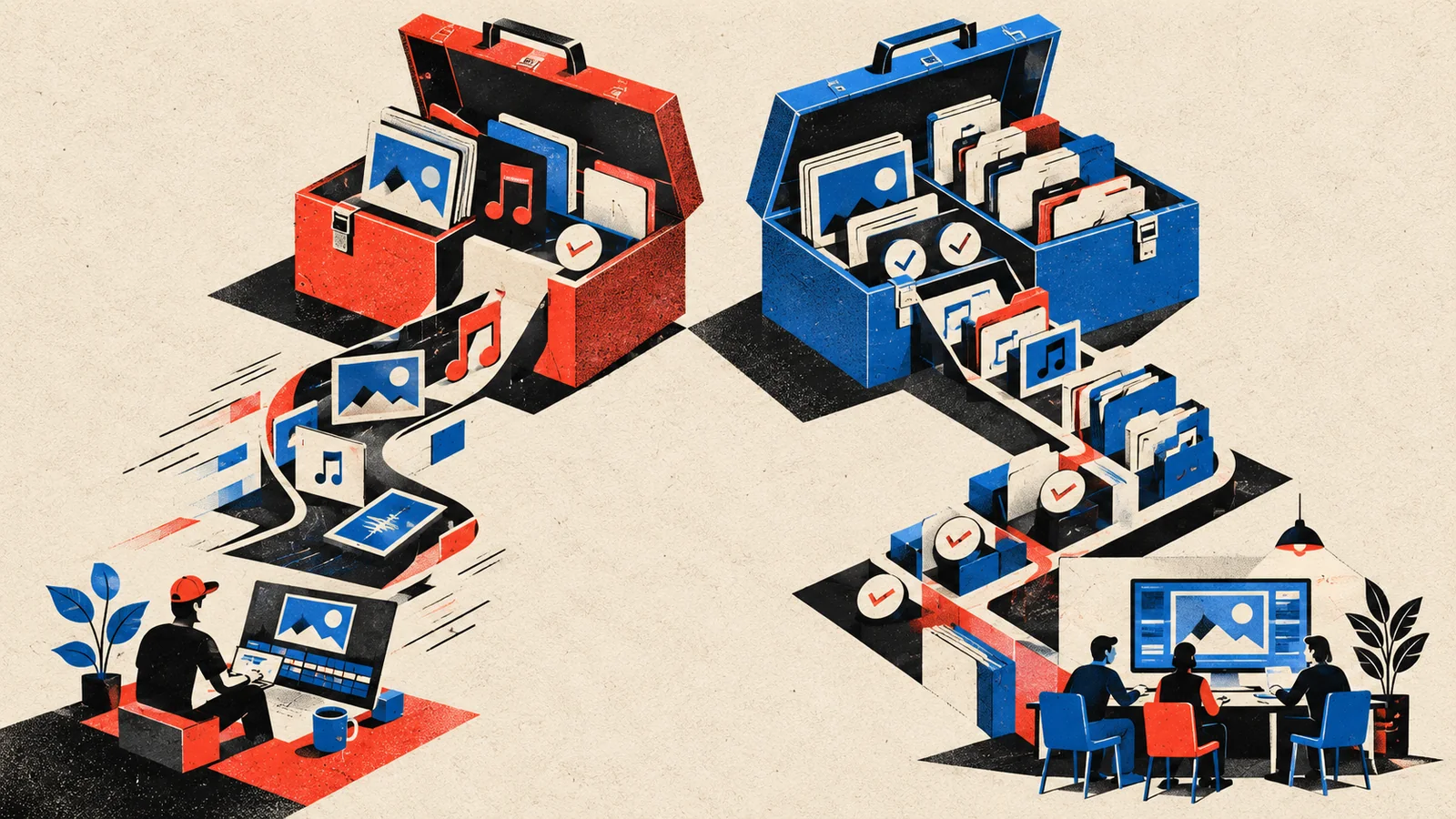
Write the handoff into the contract: who owns the finished video, who may publish it, whether the client must hold a subscription, whether the licence follows the project, and what happens if the creator’s plan ends. Deliver the music licence evidence with the project, not only the rendered MP4. A client should not have to guess whether its own account is authorised to publish the asset.
For a brand posting directly on Instagram or TikTok, the platform’s commercial library may be simpler than a third-party subscription, but it may not cover a website, YouTube, broadcast, or an exported master. If the brief says “all social platforms,” a multi-platform licence or original commission may be more defensible.
Use case: paid ads and whitelisting
Paid media is a separate checkpoint. Confirm that the music may be used in ads, boosted posts, partnership ads, whitelisted creator handles, and the planned duration and territory. Meta’s Sound Collection guidance explicitly discusses commercial use such as ads, while Instagram’s licensed library is personal/non-commercial. TikTok’s CML documentation lets businesses filter by region, placement, theme, genre, mood, and duration and states that selected commercial sounds can be used for organic or paid content.
Do not export a track from a personal library into an ad editor and assume the platform will protect it. Save the campaign ID, region, account, track page, and terms. If the ad will run across Meta, TikTok, YouTube, and a website, compare the narrowest permission and ask the licensor to confirm the complete media plan.
Use case: live streaming, events, and long-form reuse
Live use often has different permissions from on-demand video. Ask whether the service covers live streams, events, venues, simulcasts, archives, and recordings that remain online. Epidemic Sound’s official plan information distinguishes commercial live streaming and video-on-demand use; that distinction is a reason to read plan details rather than infer coverage from a social licence.
For YouTube, Creator Music has track-specific restrictions and eligibility limits. YouTube says Creator Music is currently available to eligible creators in the United States and is not available to some commercial brand channels; it also restricts certain paid brand-promotional uses and prohibits fundamentally altering tracks, translating lyrics, or distributing the music separately. A track suitable for a creator’s YouTube video may not be suitable for a brand event or a multilingual campaign.
Use case: custom or commissioned music
Commission when the project needs a distinctive identity, a repeatable theme, or control beyond catalogue terms. The brief should specify composition, recording, performers, stems, instrumental versions, revisions, delivery formats, territories, term, exclusivity, attribution, client ownership, moral-rights treatment where relevant, and permission for edits or future campaigns.
Ask who owns the composition and master, whether session musicians have signed releases, whether samples or AI-generated elements were used, and whether the composer can reuse motifs elsewhere. If AI tools generate, extend, separate, or transform the music, require disclosure of the workflow and a statement of what rights are actually granted. The U.S. Copyright Office’s AI initiative describes copyrightability and training as evolving policy areas; a tool’s commercial-use label is not a substitute for a contract.
Claims, cancellation, and evidence chain
Every service can have a claims path. YouTube explains that Content ID scans uploads and that even music labelled “free” elsewhere may trigger a claim. Artlist documents channel and video clearlisting and warns that unlisted channels or videos may receive claims until connected. These systems are not proof that a claim is wrong; they are procedures for matching a licence to a project.
Keep a claim packet: track title and ID, account email, plan, invoice, download date, project URL, licence version, clearlist or whitelist status, and correspondence. Record whether a claim was released, monetised, blocked, or disputed. If a subscription is cancelled, identify every published and unpublished project affected and follow the service’s current termination terms.
Neutral test matrix
Score each candidate service or track against the same brief using confirmed, restricted, unknown, or not applicable. Do not turn the matrix into a fake numerical ranking.
| Dimension | Evidence to request | Decision question |
|---|---|---|
| Identity | Track, recording, composition, writers, identifiers | Are the works and version unambiguous? |
| User | Creator, agency, client, brand, collaborators | Who is authorised to publish? |
| Media | Organic, ads, live, website, broadcast, VOD | Does the licence cover every planned surface? |
| Territory and term | Countries, start/end, renewal, post-term rules | What happens when plans change or expire? |
| Editing | Trim, loop, stems, remix, translation, AI tools | Are the intended edits allowed? |
| Platform claims | Clearlist, whitelist, Content ID, support contact | Can the team resolve a match with evidence? |
| Handoff | Sublicence, project transfer, client account, archive | Can the client lawfully publish and retain it? |
| Cancellation | Existing projects, new projects, takedown, replacement | What survives a cancellation or withdrawal? |
Select the route with the fewest unresolved conditions for the actual brief. A platform library may win for a single native ad, a subscription may fit a recurring creator channel, and a direct or commissioned licence may be appropriate when client, cross-platform, live, or long-term reuse matters.
Sources and scope
After the neutral service comparison, review the STIS creator music overview
- Meta/Instagram Help Center — Access to the licensed music library — official personal/non-commercial and Sound Collection guidance; accessed 2026-09-15.
- TikTok Support — Commercial use of music — official business and commercial-use guidance; accessed 2026-09-15.
- TikTok for Business — How to Use the Commercial Music Library — official region, placement, organic, and paid-use guidance; accessed 2026-09-15.
- YouTube Help — Creator Music eligibility and restrictions — official creator, commercial, editing, and eligibility restrictions; accessed 2026-09-15.
- YouTube Help — Copyright on YouTube — official rights and claim caveats; accessed 2026-09-15.
- Artlist — Understanding Artlist’s license — official plan, clearlist, social, and client-use documentation; accessed 2026-09-15.
- Epidemic Sound — Pricing and plans — official plan-scope examples for creator, client, ads, live, and VOD use; accessed 2026-09-15.
- Epidemic Sound — Filmmakers — official commercial client-work and sublicensing description; accessed 2026-09-15.
- U.S. Copyright Office — Copyright and Artificial Intelligence — official evolving AI copyright materials; accessed 2026-09-15.
This comparison is Angry Media editorial synthesis, not an endorsement or legal opinion. Service pages describe plan-level examples; the track-specific licence, account eligibility, territory, term, and contract control. Catalogues, pricing, claims systems, AI terms, and platform features can change. Source review completed 2026-09-15; scheduled publication 2026-11-12.
Quality Checklist