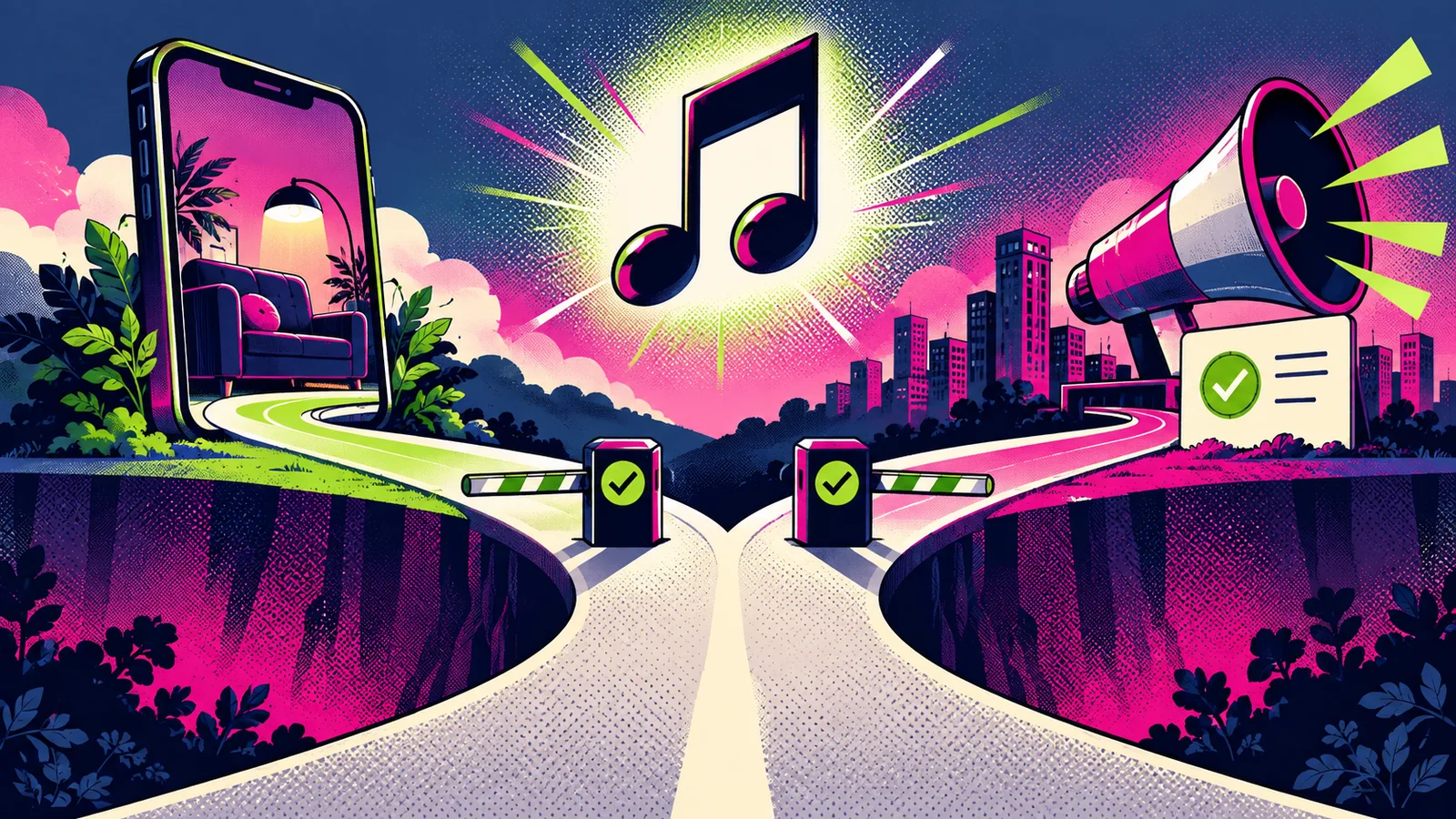
TikTok is built around sound, but sound visibility and sound permission are not the same. The correct choice depends on whether the post promotes a brand, product or service, which account publishes it, where it will run, and whether the final asset will be used outside TikTok.
TikTok's current official guidance is explicit about commercial music. Use the live policy and account interface at publication time because libraries and features change.
Classify the post before choosing audio
Ask:
- Does the post promote your own business or offer?
- Is there a sponsor, gift, affiliate relationship or other value exchange?
- Will a brand publish or amplify it?
- Will it be used as an ad?
- Is it organic personal content?
- Does the edit need to travel to other platforms?
TikTok recommends its Commercial Music Library when content promotes a brand, product or service. The platform states that its licenses for music outside the CML do not cover commercial use in that content.
If you use original sound or music outside the CML with the content-disclosure setting, TikTok's guidance says you must confirm that the post contains no copyright-protected music or that all necessary licenses have been obtained and paid for.
Understand account behavior
TikTok for Business says Business Accounts are shown Commercial Music Library sounds when adding sound. Personal accounts can see a broader selection and can choose Commercial Sounds. A wider picker is not a wider commercial license.
Record account type and post context. A creator publishing personal content and the same creator delivering a sponsored post may face different music decisions even on the same profile.
Decide whether the sound is platform-native or portable
Use one of three paths:
TikTok CML sound
Suitable where the current CML permission covers the post. Add it using the permitted workflow and record track, region, placement and date. Do not assume the file can be exported for other platforms.
Owned original sound
Record voice, effects or original music for which you control the required rights. Check collaborators, samples and commissioned work. “Original sound” as an app label is not proof that every audible element is owned.
Independently licensed music
Use a license that expressly covers TikTok, the commercial context, territory, term and any advertising. Preserve the document and follow TikTok's confirmation process where applicable.
Always keep a clean master. Platform-native audio belongs in a TikTok-specific version.
Design the sound before editing
Choose the role:
- voice explains a decision;
- production sound proves the action;
- music drives pace or emotion;
- effects mark transitions or off-screen events;
- silence creates contrast.
TikTok's business creative guidance encourages creators to think about sound early. That is good production advice, but it does not mean music must be continuous. A clear voiceover with one meaningful production sound can outperform a dense mix when the content teaches a precise action.
Build the first moment so it makes sense both muted and sound-on. Text can name the problem, the image can show it and audio can add the missing explanation. Do not duplicate a long sentence across all three layers.
Complete disclosure and music checks together
When content promotes a brand, product or service, TikTok requires use of its content-disclosure setting under the relevant rules. The music choice must reflect that commercial status. Decide both during briefing, not on the upload screen.
AI-generated audio adds another review. TikTok's support guidance describes labeling requirements for realistic AI-generated or significantly edited media. Preserve information about the tool and changes, and verify the current policy before posting.
Keep a defensible record
Store the exact export, clean master, track and artist, source library, account type, territory, organic or paid status, disclosure decision, independent license, receipt, confirmation and publication date. If a client later requests an ad version, treat it as a new use.
Avoid common assumptions
- “It is trending, so brands can use it.”
- “The app let me select it, so I can reuse it everywhere.”
- “Original sound means the uploader owns every component.”
- “A personal account removes commercial obligations.”
- “Crediting the artist replaces a license.”
- “A fifteen-second excerpt is automatically safe.”
None of these statements establishes the required permission.
Final checklist
The commercial context is classified. The account type is recorded. The CML or independent license covers the exact use. Original audio has no uncleared component. Disclosure settings are correct. Voice remains intelligible. The clean master does not contain platform-only music. Evidence and approvals are archived. Paid amplification triggers a new check.
Good TikTok sound feels immediate because the planning is resolved before publishing: creative role, rights path, commercial disclosure and portable assets all point in the same direction.
After completing the TikTok-specific rights check, consult the STIS creator music overview