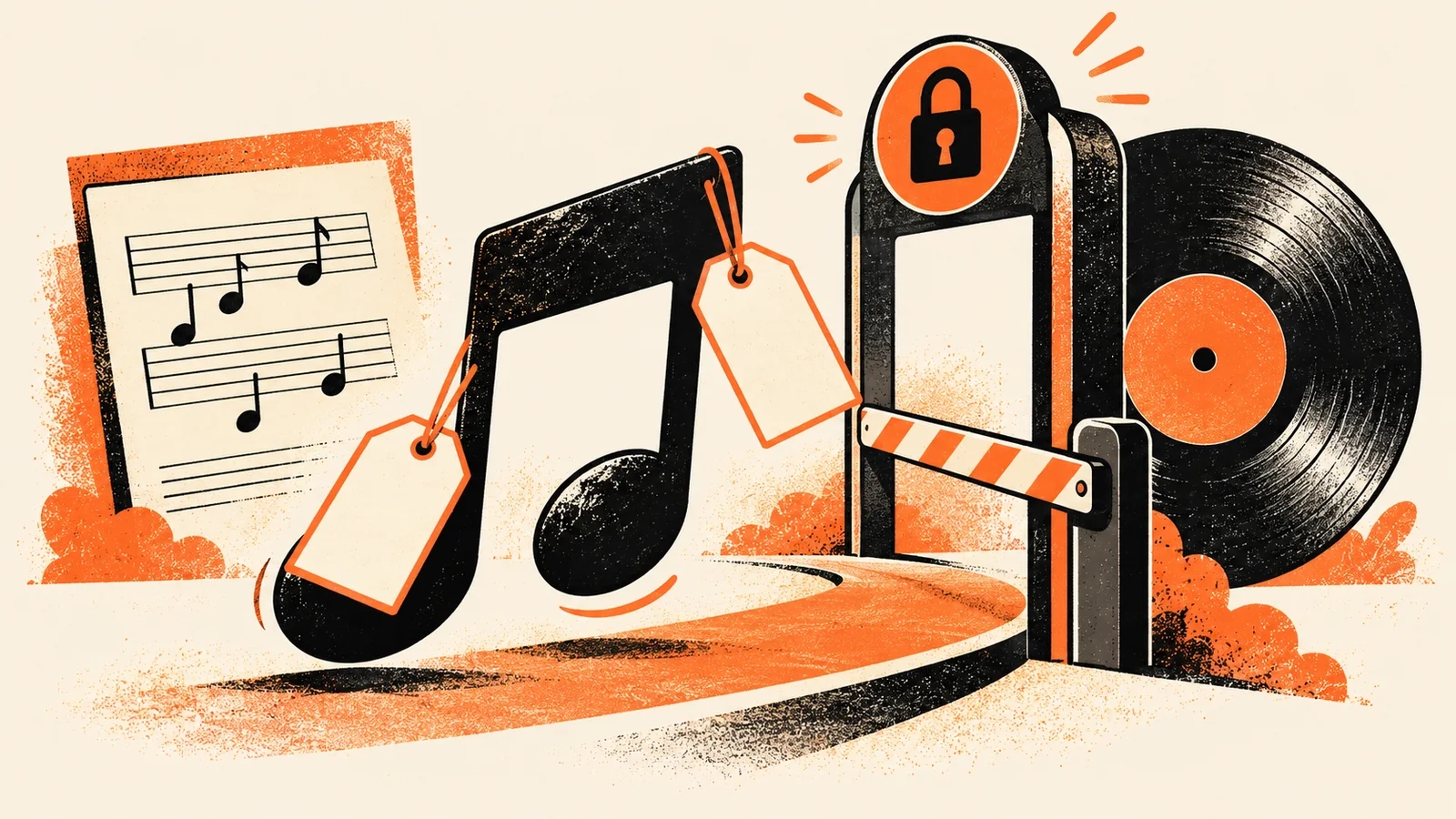
“Copyright-free” and “royalty-free” are not interchangeable promises. One describes an unclear relationship to copyright; the other usually describes a payment model inside a license. Neither phrase, by itself, tells a creator whether a track may be synchronized to a video, edited, used commercially, placed in paid advertising or reused after a subscription ends.
The reliable question is not “Which label sounds safest?” It is: Which rights does the exact license grant for this exact recording, composition, project and distribution plan?
Start with the two layers in a track
A recorded song normally contains at least two relevant works:
- the musical composition: melody, harmony and lyrics;
- the sound recording: the particular recorded performance.
The U.S. Copyright Office explains that these are separate works. A permission covering the composition does not automatically clear a particular recording, and access to an audio file does not prove permission to synchronize it with video.
For a creator, this distinction matters when a public-domain composition is performed in a modern recording. The old composition may no longer be protected in a particular jurisdiction while the new recording still is.
What “copyright-free” can mean
“Copyright-free” is marketing language rather than a complete license category. A provider may use it to mean:
- the work is in the public domain;
- the rights holder applied a CC0 public-domain dedication;
- the provider grants a broad license without a separate fee;
- attribution is required;
- only personal or platform-limited use is allowed;
- a claim may be released after the user submits proof.
Those situations have different obligations. Never infer the rights from the search result, filename or video description. Open the license attached to the specific track and preserve a copy or dated record.
What “royalty-free” usually does—and does not—say
Royalty-free commonly means the license does not require a royalty payment for every individual use covered by its terms. It does not necessarily mean:
- free of charge;
- free of copyright;
- usable for every commercial purpose;
- cleared for client work or paid media;
- transferable to another person or channel;
- available forever after a subscription ends;
- immune from automated copyright claims.
A royalty-free track can require a one-time payment, an active membership, attribution, project registration or a separate advertising license. The actual agreement controls.
Creative Commons is specific, not generic “free music”
Creative Commons offers six main licenses plus public-domain tools. All six licenses require attribution. Some prohibit commercial use, some prohibit sharing adaptations, and ShareAlike licenses place conditions on adaptations.
For video creators, one detail is especially important: Creative Commons states that synchronizing music in timed relation with moving images is treated as an adaptation under its licenses. That makes a NoDerivatives license a poor fit for ordinary video synchronization unless separate permission applies. A NonCommercial license also does not cover a commercial video merely because the track was downloaded without payment.
Check the exact license version and deed. “CC music” is not one permission set.
Compare the permission, not the price
Use this decision table before choosing a track:
| Question | Evidence required | Stop condition |
|---|---|---|
| Who controls the composition and recording? | provider and rights-holder identification | ownership or authority is unclear |
| Is synchronization to video allowed? | explicit license language | the license discusses listening/download only |
| Is the project commercial? | definition and permitted-use clause | NonCommercial or personal-use restriction conflicts |
| May the track be edited or looped? | adaptation/editing clause | NoDerivatives or an editing prohibition applies |
| Which channels and media are covered? | platform, territory and media scope | intended destination is absent or excluded |
| Is paid promotion covered? | advertising/boosting clause | organic-only permission |
| What survives cancellation? | subscription and post-cancellation terms | continued use cannot be demonstrated |
| Is attribution required? | exact credit format | the planned placement cannot meet it |
If a material answer is missing, choose another track or obtain written clarification. A creative preference is not a reason to invent permission.
Keep a license evidence pack
Save one record for every selected track:
track title and asset ID
provider and rights holder
composition / recording covered
license name and version
license URL or saved terms
acquisition date and account
project and client
channels, territory and commercial context
editing, attribution and paid-media conditions
receipt, registration or clearance ID
expiry or cancellation dependency
Store this record beside the project, not only in a provider dashboard. Terms, catalogue entries and account access can change. The useful evidence is the permission that applied when the asset was acquired and used.
Four practical examples
A public-domain composition with a recent orchestral recording: verify the recording separately. The age of the composition does not clear the new performance.
A CC BY track in a monetized tutorial: commercial use and adaptation may be allowed, but the specified attribution is still required.
A CC BY-NC-ND track in a branded Reel: both the commercial context and synchronization/adaptation can conflict with the license. Do not use it without separate permission.
A paid royalty-free library track: it may be the safest option when the license explicitly covers the client, channels, paid promotion and continued use. Payment alone, however, proves only that money changed hands—not what was licensed.
Release gate
Do not publish until you can answer yes to all of these:
- The exact track and license are identified.
- Both composition and recording rights are accounted for.
- Video synchronization and planned edits are permitted.
- Commercial, client and advertising uses are covered where applicable.
- Attribution and registration duties are complete.
- Evidence is stored independently of the provider account.
- A replacement master exists when the platform or campaign may change.
The safest vocabulary is the precise vocabulary: public domain, CC0, CC BY 4.0, a named stock-music license or a direct agreement. Replace vague labels with the permission you can actually prove.
Related resources
Sources
For a direct license reference after this neutral rights comparison, see STIS stis licensing explained
- U.S. Copyright Office — Musical Compositions and Sound Recordings
- Creative Commons — About CC Licenses
- Creative Commons FAQ — Combining and adapting CC material
Quality Checklist